The Seattle Center Monorail’s route comes down to what it was built for. In 1962, it had one job: move World’s Fair crowds between downtown Seattle and the fairgrounds quickly, above traffic. It did that job so well that it still does today. Two stops, just under a mile, and about two minutes.
Key Takeaways
- The Monorail has two stations: Westlake Center in downtown Seattle and Seattle Center Station, with no stops in between.
- It was built for the 1962 World’s Fair to move crowds from downtown to the fairgrounds, and it still runs that route.
- The two stations remain useful today because Westlake and Seattle Center are major destinations and transportation hubs.
Where the Seattle Monorail Goes
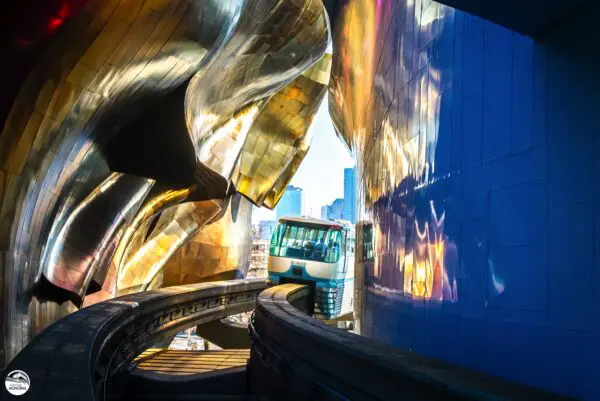
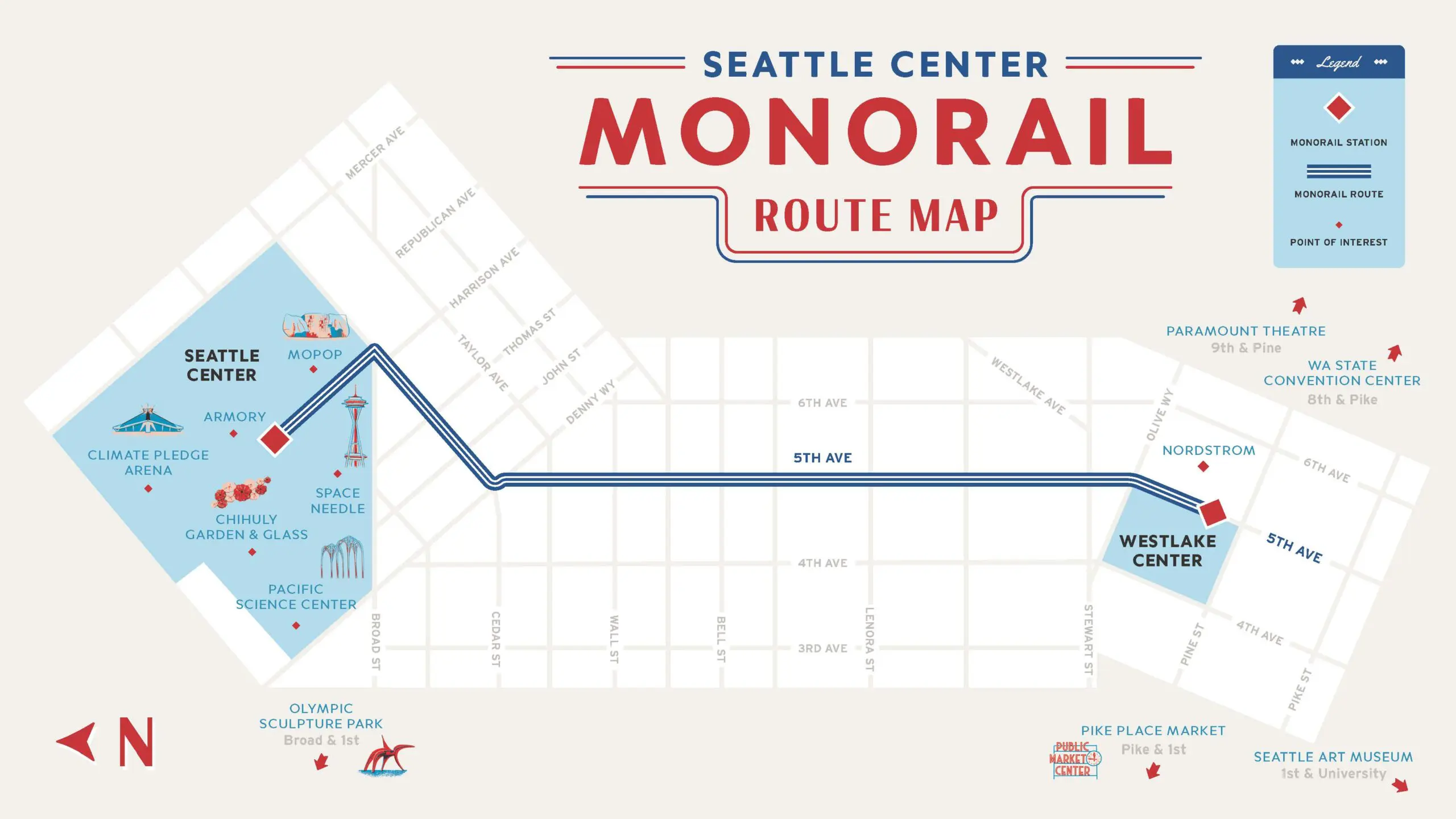
The Monorail runs between two stations. At the downtown end is Westlake Center at 5th and Pine, with the platform on the third floor and a street-level entrance on 5th Avenue. At the other end is Seattle Center Station, a short walk from the Space Needle, Climate Pledge Arena, MoPOP, and Pacific Science Center.
The trains travel along a guideway supported by 68 concrete columns about 30 feet above the street. The route is just under a mile, and the ride takes about two minutes. There’s nothing in between: no intermediate platform, no stop request, and no detour onto surface streets. That’s the beauty of the Seattle Monorail: it’s easy to navigate, with no trip confusion, and you get where you are going stress-free.
It Was Built for One Job, and It Was Built Fast
Construction started in April 1961. Alweg Rapid Transit Systems, a West German company, offered to underwrite the entire construction cost of roughly $3.5 million. It was finished in January 1962, and the Monorail opened to the public on March 24, 1962, nearly a month before the Century 21 Exposition itself.
Over the six months of the fair, the trains carried more than eight million passengers. They recovered the full initial construction cost and realized a profit before the fair ended. In 1965, the City of Seattle purchased it for $600,000.
That timeline explains the route. The Monorail had to move large crowds between two specific points, reliably and quickly, and it had to be running before the fair opened. Two stops were part of the design from the start.
Those Two Stops Are Still Two of Seattle’s Busiest Places
More than 60 years later, both ends of the line remain important destinations. That connection is why the Monorail still works today.
The Westlake Center end puts you in the middle of downtown: the retail core, hotels and offices, the Seattle Art Museum, and a walk downhill to the waterfront. Neither station sits at Pike Place Market, but Westlake Center is roughly a 10-minute walk from it, mostly downhill on the way there.
Westlake also connects with Link light rail (hello, suburbs!), King County Metro buses, and RapidRide, making it a useful transfer point for people arriving downtown by other forms of transit.
The Seattle Center end puts you in the middle of Seattle Center: the Space Needle, Climate Pledge Arena, MoPOP, Pacific Science Center, the Armory food hall, and McCaw Hall.
Seattle Built More Transit, and the Monorail Kept Its Job
In 1962, the Monorail was essentially the rapid transit link between downtown and Seattle Center. That’s no longer true, and that’s ok. Since then, Link light rail, King County Metro, RapidRide, Washington State Ferries, and the water taxi have expanded Seattle’s transportation network.
Westlake is now one of the places where several of those systems come together, so you can arrive downtown in many different ways and still finish the trip on the Monorail.
Seattle Once Planned a Much Bigger Monorail
The two-stop route wasn’t always the only Monorail plan Seattle considered.
Between 1997 and 2005, voters weighed several proposals for a citywide monorail network. The Seattle Monorail Project spent years designing a Green Line before voters ended the project in 2005.
The route running today is the one the Monorail was built for, and it remains focused on that original connection between downtown and Seattle Center.
Still The Fastest Way to Get From Downtown to Seattle Center
Two minutes sounds too short to matter until you look at the alternatives. Most other ways to make the trip involve stops, turns, traffic, or walking. On foot, the same trip is about a mile of flat terrain, but it still takes time. By car, you deal with downtown traffic at both ends and parking at Seattle Center, which gets especially difficult during major events.
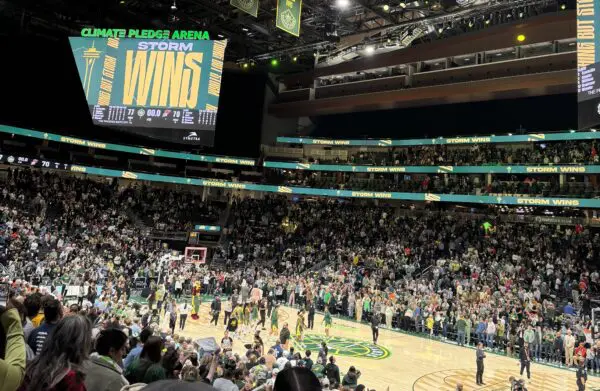
The Monorail travels above all of it. With no intermediate stops, nothing along the route slows the trip down. That’s why the two-minute ride remains consistent whether it’s a Tuesday morning or a sold-out night at a Climate Pledge Arena event.
The line stayed short for financial reasons, too. Fare revenue, not taxpayer funding, covers the Monorail’s operating costs. That makes a short, busy, direct route especially important to the system’s operation.
Two Stops, One Direct Connection
The Seattle Center Monorail has two stops because it was designed to do so. It was built to move people quickly between downtown Seattle and the 1962 World’s Fair, and those two destinations remain busy parts of the city today. More than six decades later, even as much of the city has changed, the Seattle Monorail hasn’t needed to.
Plan your ride at seattlemonorail.com.